
































We have made the difficult decision to stop shipping our paintings and prints to France, Spain and Portugal.
Other EU countries may unfortunately follow as we review them one by one.
We are a tiny family-run gallery representing three artists. We are not Amazon. We don't have a compliance department, an EU legal team or hundreds of employees.
In our experience, selling online into parts of the EU has become an extraordinary red-tape no-go zone for a small independent creative business like ours.
Our latest experience in Portugal has been the final straw.
We sold an original painting for around £4,000.
We carefully packed it and shipped it internationally. It travelled to Portugal, cleared customs and DHL attempted delivery.
The customer did not take delivery.
Over the summer we repeatedly tried to contact the customer. DHL tried to contact him. Our shipping agent, Transglobal Express, tried to resolve the delivery.Calls were not answered. Emails and messages went unanswered. The customer did not make himself available to receive the painting.
Eventually the painting had to make the entire international journey back to us.
And because the customer had not taken delivery, WE had to pay the substantial cost of having this large, valuable painting returned to the UK.
Between the original international shipment, return shipment, customs and associated costs, we are facing losses of around £1,000.
Then, after ignoring the attempts to deliver and our efforts to communicate, the customer cancelled.
And he is now claiming that WE were late refunding HIM.
He is demanding approximately €9,000 from us under Portuguese consumer legislation.
Yes, you read that correctly.
• A £4,000 painting.
• We successfully shipped it to his country.
• Delivery was attempted.
• He did not make himself available to receive it.
• Repeated communications seeking to complete delivery went unanswered.
• We had to pay the enormous cost of bringing it all the way back.
We lost around £1,000.
He then cancelled.
And we are now facing a demand of over €9000
We dispute the claim and whether the legislation applies in these circumstances.
We cannot know somebody else's intentions. But viewed retrospectively, the sequence of events looks deeply troubling to us and raises the question of whether extraordinarily punitive consumer legislation can be deliberately exploited.
Consider the potential pattern from a small retailer's perspective.
• Order an expensive item online.
• Allow the seller to spend substantial sums preparing and shipping it internationally.
• Don't make yourself available for delivery.
• Don't answer the courier.
• Don't answer the shipping agent.
• Don't answer the retailer's calls or emails.
• Allow the goods to be returned internationally at the retailer's expense.
• Then cancel.
• Then invoke punitive refund legislation and seek substantially more money than the original purchase price.
We are not alleging that EU or Portuguese legislation was designed to enable this behaviour, nor are we stating as fact what motivated this particular customer.
But from where we are standing, the potential for abuse is obvious and frightening.
Portugal has legislation under which failure to make a qualifying consumer reimbursement within the statutory period can result in double the amount paid becoming due.
France has its own severe late-refund penalty regime, while Spain also provides for double repayment in certain late-refund circumstances.
Then there is the wider EU distance-selling regime.
Consumers buying online generally have a 14-day right to withdraw without giving a reason. The EU is also introducing requirements for an easily accessible online withdrawal function, effectively a 'withdraw from contract' button available throughout the withdrawal period.
And that's only consumer law.
Then there is GPSR, the General Product Safety Regulation.
For products within its scope, businesses outside the EU generally need an EU-based Responsible Person. Online listings can require manufacturer details, postal and electronic addresses, Responsible Person information, product identification and applicable warnings or safety information.
Products also require traceability using a type, batch or serial number or another identifying element.
That means small businesses having to think about SKUs, product identifiers and, where required by a particular product, marketplace or other applicable regime, GTIN/EAN codes.
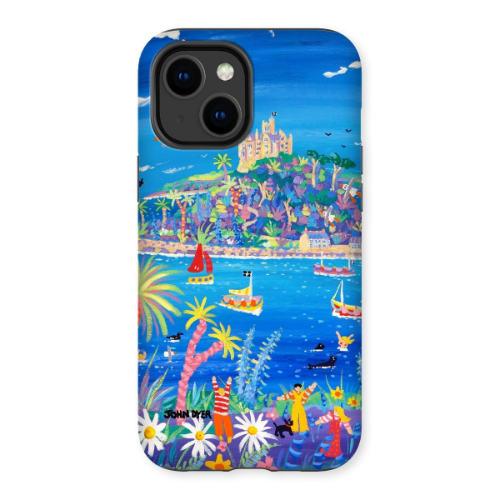
We paint pictures.Unique pictures. And create Art Prints.
Sometimes there is literally only one in existence.
Yet simply selling products into this market can mean dealing with product identifiers, traceability, EU Responsible Persons, online compliance information, packaging regulations, national producer-responsibility schemes, labelling requirements and potentially multiple languages.
Then, from August 2026, the EU's new Packaging and Packaging Waste Regulation began to apply, creating another EU-wide regulatory framework for packaging, recyclability, labelling and waste reduction, with further requirements being phased in.
Alongside this, the EU is developing Digital Product Passports, adding another layer of digital product information and traceability as relevant product categories are brought into the system. It is an impossible layer cake to destroy business.
Consumer protection.
GPSR.
EU Responsible Persons.
Product identifiers.
SKUs and, where applicable, GTIN/EAN codes.
Traceability.
Packaging regulations.
Producer-responsibility schemes.
Labelling.
Distance-selling rules.
Withdrawal rights.
Online cancellation functions.
Refund deadlines.
National penalty regimes.
Digital Product Passports.
At some point, and for us it is mow, it becomes ridiculous.
Every individual regulation will have somebody explaining why that particular regulation is necessary.But who is looking at what happens when you pile all of them on top of a family business employing only a handful of people?
And now there is AI.
We are increasingly receiving lengthy and sometimes aggressive legal correspondence from customers, apparently created with the assistance of AI tools such as ChatGPT.
A consumer can now generate pages of impressive-looking legal arguments, regulations and demands in seconds.The tiny business receiving them then has to spend hours establishing whether those claims are actually correct, researching foreign legislation and potentially paying lawyers for advice.
We believe strongly in sensible consumer protection.
Customers should be protected from dishonest traders, unsafe products and businesses that take their money and fail to deliver.
But honest businesses need protection too.
A system in which a small retailer can genuinely attempt to deliver a £4,000 painting, have repeated communications ignored, be forced to pay to bring that painting back from another country, lose around £1,000 in the process and then face a demand approaching €9,000 is, in our view, completely disproportionate.
We also don't say this as people who have never experienced life inside the EU.
We lived in France and ran our business from there for three years.
We experienced the administrative environment ourselves and watched other people struggle with the bureaucracy involved in running businesses within the EU.
That experience profoundly changed our view.
We know many people will strongly disagree with us, but personally we are enormously grateful that our business is now based in the United Kingdom, outside the European Union.
Long may that remain the case.
In our experience, the EU has become excessively bureaucratic and increasingly authoritarian in its regulatory approach, with layer after layer of rules imposed without enough consideration of their cumulative effect on the smallest businesses.
That is our opinion, formed not from newspaper headlines but from having actually lived and run a business inside the EU and subsequently having to navigate its rules as an exporter.
Eventually small businesses don't 'comply harder'. They leave.That is what we are doing.
We will no longer ship to France, Spain or Portugal.
We will now review the remaining EU countries individually and switch them off where we conclude that the regulatory or financial exposure is disproportionate.
Our advice to other independent artists, craftspeople and small online businesses is simple.Think very carefully before selling online into countries with these sorts of rules.Don't assume that because you are tiny the regulations don't apply to you.
Don't assume that because you have behaved reasonably, shipped the goods and genuinely tried to deliver them you cannot find yourself facing an enormous legal demand.
• Understand the cancellation rules.
• Understand the refund deadlines and penalties.
• Understand GPSR.
• Understand EU Responsible Person requirements.
• Understand product identification and traceability.
• Understand packaging and producer-responsibility rules.
And, most importantly, understand exactly how much money you could potentially lose on a single transaction.
We have wonderful customers throughout Europe and it genuinely saddens us to exclude them. They are the people who ultimately lose out when regulation makes small overseas businesses decide that serving a market simply isn't worth the risk.
But we cannot expose our artists, our family and our small business to this level of financial and regulatory risk simply for sending somebody a painting.
For us, enough is enough.
We would much rather be painting.


Please confirm your sign-up in your inbox. If you do not see our email, check your Junk or Spam folder and add sales@johndyergallery.com to your safe senders list.