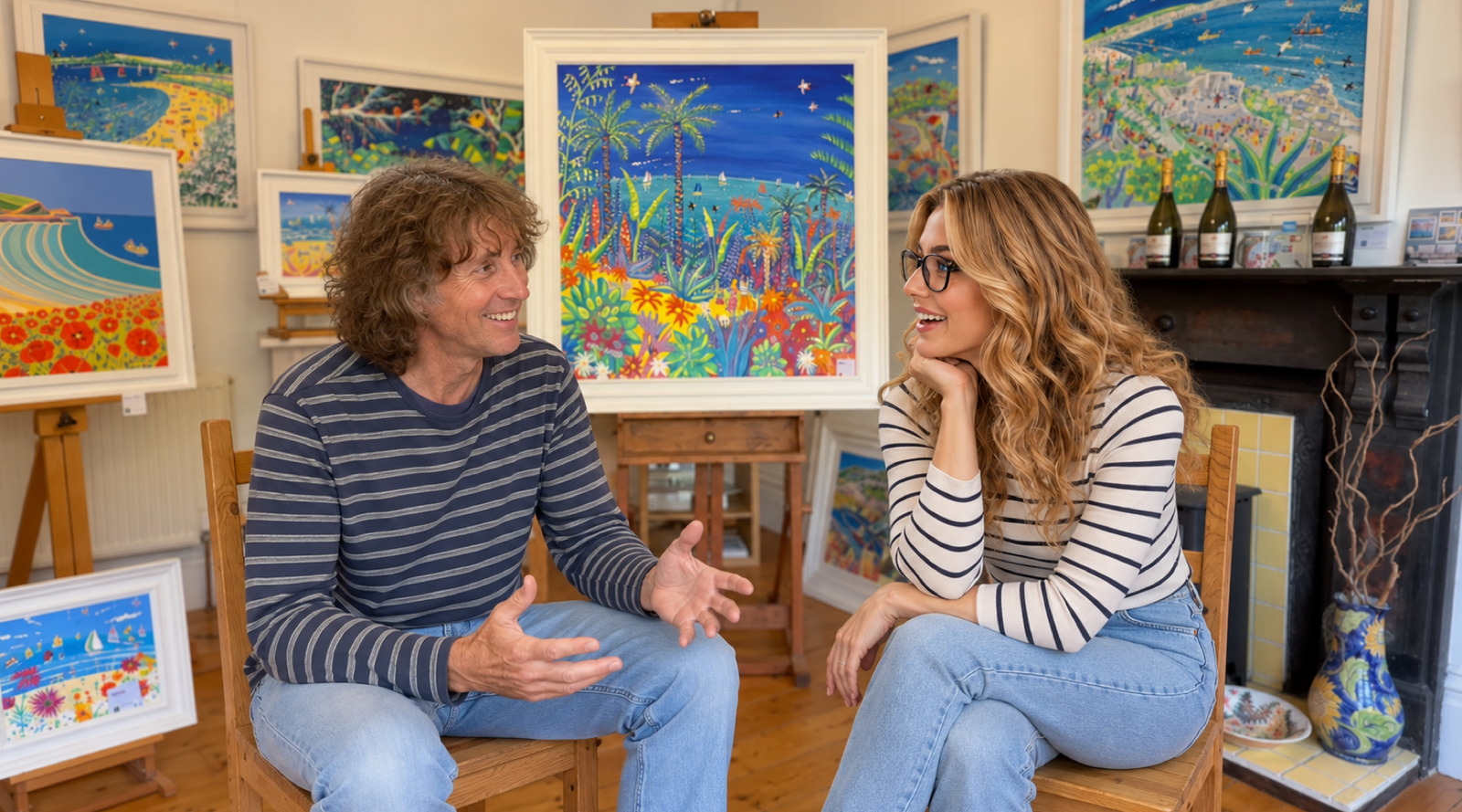















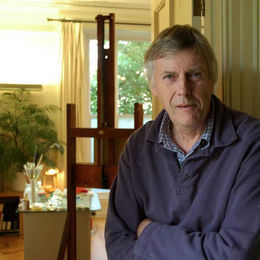
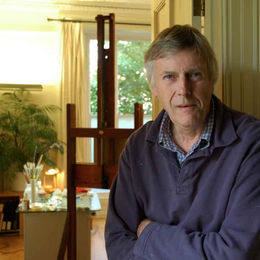










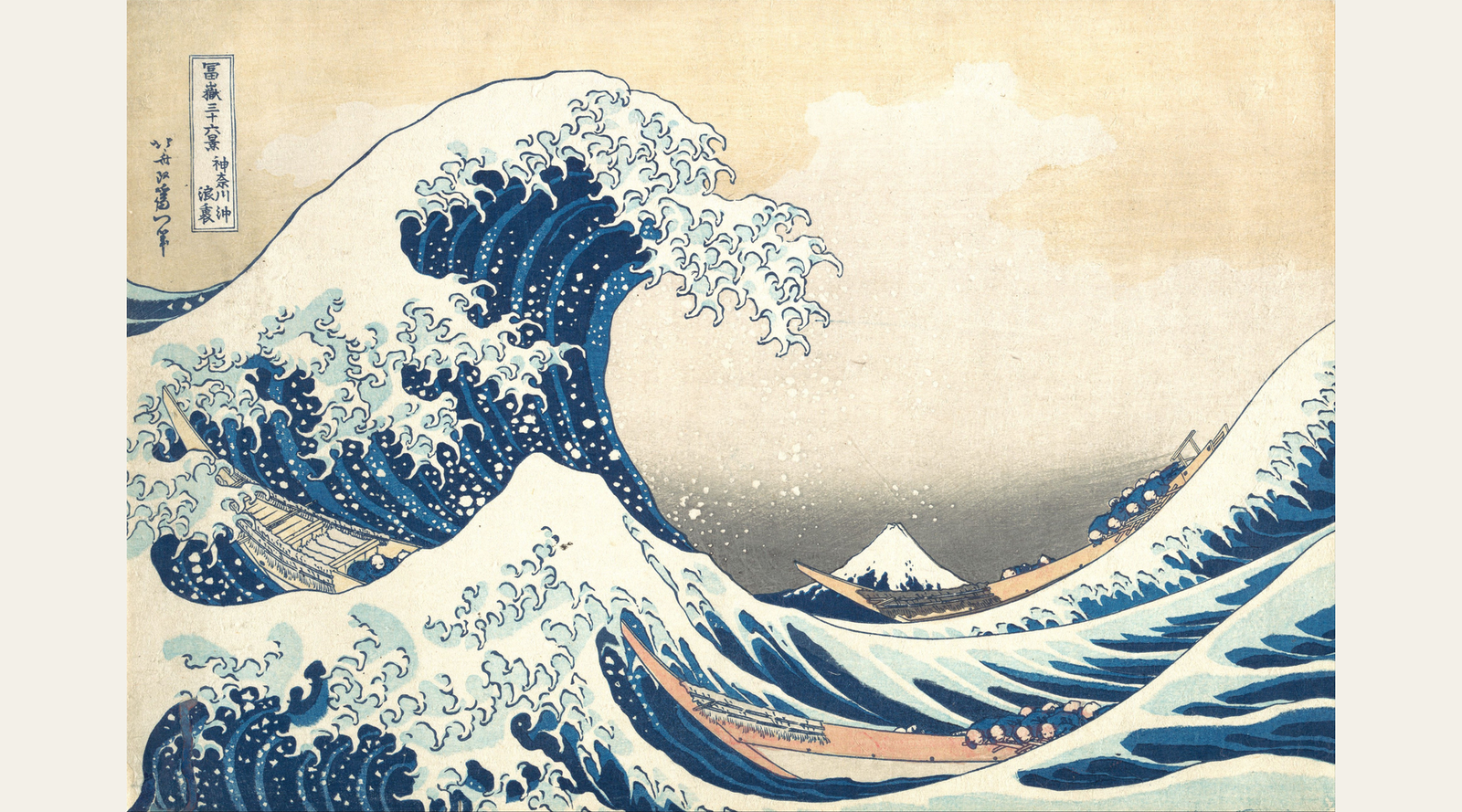

The wave may be famous, but for John Dyer the first thing to notice is the mountain. In Hokusai’s The Great Wave off Kanagawa, the curling water creates a remarkable space around Mount Fuji, while the mountain itself seems to rise like another wave. That connection between earth and water gives us a way into the print’s meaning: look at how its shapes belong together, as well as the danger faced by the small boats below.
At The John Dyer Gallery, we bring an artist’s close looking together with museum research to explore the print’s composition, colour and collaborative craft. The historical images below help place it in its world; our imagined film offers another way into those discoveries.
Shop the featured artwork
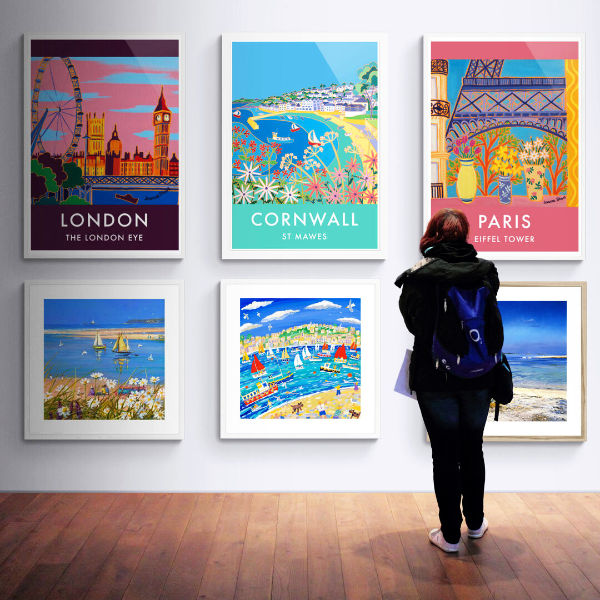
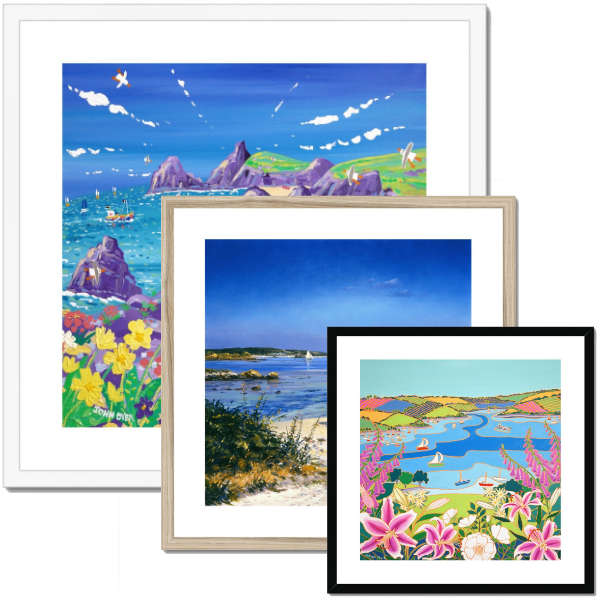
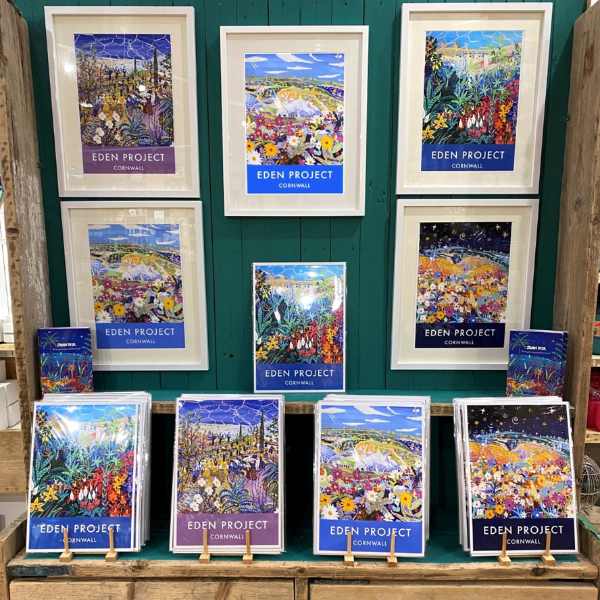
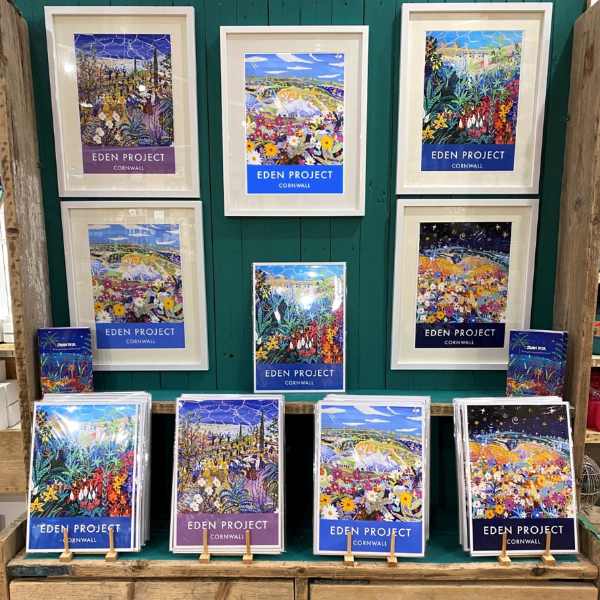
Explore the Gallery editions of the artwork featured in this adventure. These are modern reproductions, distinct from the historical original discussed below.

Choose the unframed edition and select a frame to suit your space.
View unframed fine-art print →
Explore the framed and mounted edition, with the available sizes and finishes on the product page.
View framed and mounted print →Written by The John Dyer Gallery. Historical research reviewed 29 September 2026; John Dyer’s artist perspective and additional sources reviewed 9 October 2026. The film is a fictional time-travel reconstruction; historical sources and production images are identified separately below.
The artwork at a glance
- Artist: Katsushika Hokusai (1760–1849).
- Title: Under the Wave off Kanagawa (Kanagawa oki nami ura), commonly called The Great Wave off Kanagawa.
- Series and date: Thirty-six Views of Mount Fuji, about 1830–32, during Japan’s Edo period.
- Technique: polychrome woodblock print—ink and colour on paper, not an oil painting or lithograph.
- Our image reference: The Metropolitan Museum of Art’s impression JP1847, measuring 25.7 × 37.9 cm. These are the museum’s recorded dimensions for this particular impression.
The Met’s object record provides the catalogue facts and public-domain image.

What does The Great Wave off Kanagawa mean?
The British Museum identifies the vessels as oshiokuri: swift boats carrying fish towards Edo’s market. That detail gives the scene an everyday human purpose. These people belong to a working world of transport, skill and livelihoods; they are more than small shapes included to show how large the wave is. See the British Museum’s catalogue discussion.
The series takes Mount Fuji as its recurring subject, yet here the mountain appears tiny beside the foreground water. Asked what he notices first, John’s answer begins with Fuji:
For me, the first thing I see is Mount Fuji.
He sees the great wave creating a dynamic negative space around the mountain, almost framing it. Fuji’s rising shape then echoes the water itself. In his reading, earth and water come together visually: the quiet, distant mountain and the restless foreground crest are connected by the drawing.
Try covering the crest briefly with your hand while viewing the reproduction. Notice the boats and mountain first, then uncover the wave. Does the picture feel different? This is the small change of attention that our film’s closer view of the boats and Fuji was designed to encourage.
Seeing Mount Fuji from the bullet train
That distant mountain also carries a personal memory for John. During his 2007 touring exhibition in Japan, he saw Mount Fuji from the bullet train, rising suddenly from the surrounding landscape. He remembers its iconic form breaking the largely flat horizon almost abruptly. Hokusai’s small mountain brings that extraordinary presence back into view.
Our 2007 account of John’s Japan exhibition tour records Happy Summer Paradise travelling to Kyoto, Kobe, Osaka and Tokyo with Hibell. It is a Gallery connection that runs in both directions: Japanese prints helped European artists find new ways of seeing, and John’s own paintings of Cornwall later travelled to Japanese collectors.
Is Hokusai’s Great Wave a tsunami?
It is more plausibly read as a large storm or rogue wave than as a documented tsunami. The US Geological Survey cautions that the image’s frequent use to illustrate tsunamis does not establish what Hokusai meant. It suggests a rogue wave or even a sailor’s imagined account as better ways of thinking about the scene. We therefore avoid presenting the print as a record of a particular earthquake or disaster. Read the USGS explanation.
A 2013 paper by J. M. Dudley, V. Sarano and F. Dias, published in Notes and Records of the Royal Society, examines the wave as an extreme breaking storm wave. The authors compare its localised shape with a photographed ocean wave. Their discussion supports a physical possibility, not proof that the artist witnessed a particular event; they explicitly leave the source of his inspiration unresolved. Read the open-access scientific paper.
What makes a tsunami different?
A tsunami is a series of waves generated by a major disturbance of water, commonly an undersea earthquake. It can travel across deep water without the towering height we associate with disaster photographs, then grow dramatically as it reaches shallower water. It is not simply another name for a very large curling wave. NOAA also discourages the misleading term “tidal wave”. NOAA explains the distinction.
That does not make the print less powerful. It invites us to look again: are we seeing helplessness, practised seamanship, a moment of danger, or several of those things at once? The image can sustain a personal response without our turning an interpretation into an established historical fact.
Hokusai, Edo and a new kind of blue
Hokusai was already in his seventies when he designed the Mount Fuji series. The Smithsonian’s teaching resource describes an artist whose early training included woodblock carving and printing, and whose lifelong practice extended well beyond the one image through which many of us first meet him. Explore the Smithsonian’s Hokusai and Slow Looking resource.
The Met’s scientific account places an advertisement for the series around the New Year festivities of 1831. It also explains why the colour deserves attention. Prussian blue was newly available to the print market, but the printers did not simply replace indigo with one new ink. Analysis of the museum’s print found a more sophisticated combination: the pigments were mixed for an outline and printed over one another to deepen the blue while retaining its intensity. Marco Leona’s The Great Wave: Anatomy of an Icon describes the findings.
Exquisite drawing, restrained colour
For John, the drawing is one of the print’s great pleasures: spectacularly skilful, yet supported by a remarkably restrained use of colour. He notices the soft yellows working against the rich blues in an almost complementary way. The palette stays limited while the picture remains intensely powerful.
His response helps us connect the pigment research to what we actually see. Those deep blues carry the water’s weight and movement; the warmer passages give the eye something different to rest on. Looking at the complete print, rather than isolating the crest, lets the drawing and colour work together.
This matters to the way we tell the story. A bowl of blue ink is an evocative detail, but one attractive brush stroke cannot explain the finished print. Its beauty rests partly on repeated, controlled decisions made by skilled people. Our short reconstruction compresses that work; it cannot demonstrate the complete colour sequence.
Why Japanese prints opened a new way of seeing
John’s response reaches beyond this one sheet to the influence Japanese prints had on Impressionist and Post-Impressionist painters, including Monet and Van Gogh. He is struck by the way Hokusai gives water energy and movement without depending on realistic reflections. The force of the wave lives in the shapes, lines and rhythms of the image.
The essence of a great wave becomes every bit as powerful as the great wave itself.
That wider history is well documented. The Asian Art Museum’s Looking East exhibition, organised by the Museum of Fine Arts, Boston, explored Japanese art’s influence on artists including Monet and Van Gogh. The Van Gogh Museum’s account of Japonism describes the appeal of broad areas of colour, strong contours, diagonals, unusual compositions and close views of everyday life.
John’s point is that a work can feel more powerful through the character it captures. Hokusai distils the wave, mountain and boats into shape, line, colour and movement, making their different forms feel connected. As John puts it:
The result is an image that feels both completely observed and completely imagined.
How was the Great Wave made?
Japanese colour woodblock printing involved a collaboration between designer, carver, printer and publisher. A design was translated into carved printing surfaces; colours required successive printing stages. The paper had to return to the intended position so that the separate parts of the image aligned.
The Met describes registration marks, known as kentō, and the use of a baren, a hand-held rubbing pad applied to the back of the sheet. The carved surface transfers its design in reverse. This is why the printing face of a block cannot simply repeat the finished image’s orientation. Read The Met’s explanation of ukiyo-e printmaking.
The British Museum’s study of different impressions offers another useful correction: there is no single identical “original” sheet against which all others must look exactly the same. Wear and changes during printing help researchers compare impressions. We chose one identified museum image as our reference, keeping its provenance and dimensions attached to it. Explore The Great Wave: spot the difference.
Watch Aria’s imagined visit to an Edo print workshop
Aria is our fictional art adventurer. In the film, we place her in Edo, now Tokyo, for an imagined encounter with Hokusai and a specialist printer. The location named in the artwork’s title and the reconstructed workshop setting are different things: a picture of the sea off Kanagawa does not identify the room where a surviving impression was printed.
The imagined encounter lets us step close to the tools and people behind the print. Its scene and dialogue are storytelling; the artwork and the historical references below are the evidence we can explore.
The historical images behind our time travel
A crowded Edo seen through Hokusai’s own work
Our production plan includes Nihonbashi in Edo, another print from the Mount Fuji series, dated about 1830–32. The Met explains how its cropped foreground places the viewer among the crowd at the bridge. We used this period image as visual context for an inhabited city, rather than treating modern streets or a generic “old Japan” setting as evidence.


For a scene to feel inhabited, the background needs a purpose. In this arrival frame, people move through the street while work gathers at the threshold. The historical print encouraged us to think about a city connected by movement and trade.
Clothing, hair and the limits of a period reference
We also consulted Yoshida on the Tōkaidō, a contemporary teahouse scene. Its figures offered material for thinking about clothing, dressed hair and head coverings. A teahouse print cannot establish exactly what every woman wore in a workshop, however. We recorded that limitation instead of turning one image into a universal costume rule.

The V&A’s account of kimono helped with construction: straight seams, the wearer’s left side wrapped over the right, and an obi sash. Its discussion also shows why colour, decoration and accessories should not be chosen as though all settings and social roles were interchangeable. Read the V&A’s introduction. Aria’s modern glasses and recognisable loose golden hair are deliberate fictional traveller styling, recorded as exceptions in our production plan.

Dress research became a set of questions: how does the garment close, how is it held in place, what can we infer from the reference, and where have we chosen recognisability over strict period styling? The source and the film frame let you judge those choices for yourself.
Giving Hokusai a face without claiming an exact likeness
Our likeness research consulted historical portraits, including a later self-portrait reproduced in the Smithsonian resource. That image is dated around 1840–49, after the setting of our adventure. It helped inform an interpretation of an older artist; it cannot certify his exact appearance in 1831. The face in the film is a reconstruction, not an authenticated portrait brought to life.


Looking into the workshop—and out towards the print shop
Our set brings the work close: paper stacks, brushes, bowls, a work surface and another person occupied in the background. These details give the printing actions a setting, but we do not have a verified plan of the room where this impression was made.
The 1803 Utamaro print-shop scene at LACMA, consulted as further research for this article, shifts our attention from making a sheet to handling and selling prints. The displayed images and piles of paper suggest how a printed design entered a wider visual culture. It is also a useful caution: an artist’s representation of a print shop is itself a designed image. The British Museum’s discussion of the full triptych connects a workshop and a publisher’s shopfront; it does not make this a blueprint for Hokusai’s working room. Read the British Museum’s account.
How we made the printing reveal work
The most demanding question was deceptively simple: what should we see when the paper is lifted? Early experiments showed how easily a convincing-looking image could fail as an action. A sheet could change size, its printed side could appear at the wrong moment, or a block could seem to contain an unexplained version of the whole finished picture.
We broke the problem into smaller checks. The selected museum impression supplied the physical scale reference. We distinguished the blank reverse from the printed face, checked the turn and the relationship between the sheet and block, and reviewed the revised lift across its 97 output frames.


For the reveal, we placed the authentic artwork image into the edited footage locally. That keeps the authentic reproduction of Hokusai’s design within an imagined scene. The original image also supplies the close view of the boats and Fuji. This separation lets the reconstructed scene create a sense of discovery while the artwork remains the thing we actually study.
Editing was part of the solution. The finished adventure combines arrival, interaction, selected craft actions, the paper lift and a closer look at the print. Cuts compress time. They do not establish an exact historical order for every colour pass, and the film should not be used as a complete practical printmaking demonstration. Both portrait and landscape edits were checked; the wider version above gives the blog room for the setting and shared action.
How our bespoke Agent Art system works with Grok
Aria is the face of Agent Art, the Gallery’s bespoke software system. There is no single prompt that researches, films and finishes an adventure perfectly. For this episode, the work was separated into research, scene planning, reference-led generation, editing and review.
The research supplied the historical brief: the artwork, its date and dimensions, the people involved in its production and the details we could support with sources. Scene plans then set out the action, framing, dialogue and transitions. Grok generated moving scenes for the imagined visit. Our production work combined those scenes with selected craft footage, the authentic artwork image and a locally edited reveal. Portrait and landscape versions were assembled for their different viewing spaces.
Agent Art keeps the film revision, approved illustrations, source links, captions and release records together. Its normal writing route uses the OpenAI API with Gallery voice guidance and the supplied evidence. This article has also received hands-on editorial and technical work. The software helps organise the process; the historical claims still depend on their sources, and the generated scenes still need watching carefully.
The useful lesson is that a convincing result comes from many small decisions. A paper turn, a bowl of ink, a believable eyeline and a well-placed close-up each affect whether we attend to the artwork. When a generated detail fails, we review, revise or edit it rather than treating an attractive image as proof that the history or physical action is correct.
What we know, what we infer and what we imagine
- Documented: the catalogued artwork, approximate date, medium, selected impression’s dimensions, period reference prints and the researched division of printing work.
- Informed reconstruction: the room, clothing details, tools in their scene positions and interpreted artist likeness. The sources guide these choices but do not prove the exact arrangement shown.
- Fiction: Aria’s time travel, the meeting, dialogue, camera viewpoint and compressed sequence of events.
We hope the adventure sends you back to the artwork with more questions, a closer eye and the pleasure of discovering something you had missed.
Frequently asked questions about Hokusai’s Great Wave
Is the Great Wave a painting?
The work discussed here is a colour woodblock print. “Painting” is a familiar search description, but it misses the collaborative printing process that makes this story so interesting.
Does the print show a real tsunami?
There is no established identification of a particular tsunami in the sources used here. The USGS and the scientific discussion above support a more cautious storm- or rogue-wave interpretation; the artist’s precise intention remains uncertain.
Why does Mount Fuji matter?
It is the recurring subject of the series, even when it appears small. Try following the mountain’s outline, then the wave’s: the relationship between them offers another way into the composition.
When was the Great Wave made?
The museum impression we use is dated approximately 1830–32. Our imagined visit uses “around 1831” to place the story within that period; it does not claim a verified day when Hokusai first saw a completed sheet.
How large is the original Great Wave?
The Met’s JP1847 impression measures 25.7 × 37.9 cm. That is the recorded size of our chosen historical reference, rather than a claim that every surviving sheet or modern reproduction has identical dimensions.
Did Hokusai carve and print every copy himself?
Hokusai supplied the design, while ukiyo-e production involved specialist carving, printing and publishing work. The film’s distinction between a design, a carver’s skill and a printer’s hand is intended to make that collaboration visible.
Where does Aria’s time-travel story take place?
The adventure is set in an imagined workshop in Edo, now Tokyo, Japan, around 1831. The artwork shows the sea off Kanagawa. Those are different locations, and the film does not establish a documented studio address.
Are the people and workshop historically exact?
No. Museum records and period images informed the research, but the encounter, dialogue, detailed setting and photorealistic likeness are creative reconstructions. The historical artworks reproduced in this article are identified separately so that you can compare evidence with interpretation.
Can I see the print in more detail?
Yes. The linked museum records let you explore the historical images. Our Katsushika Hokusai collection brings together the Gallery’s selection. The featured artwork is available as a modern unframed fine-art print or a framed and mounted print. These are modern reproductions, distinct from the nineteenth-century impression discussed here.
Follow Aria’s art adventures for more encounters with artists, materials and moments in art history. For now, return to the wave: which feels different after watching—the small boats, the distant mountain or the sheet of paper itself?
Follow Aria’s next adventure
Come along for another glimpse into art history, with new things to notice and stories behind the work. Follow Aria on Instagram, Facebook and Youtube.
Sources and further reading
Catalogue references are linked beside the artworks. For the wave question, start with the USGS and Dudley, Sarano and Dias; for printing, The Met’s craft essay and scientific analysis; for period visual context, the two Hokusai prints reproduced above. The Smithsonian and V&A resources offer further context on the artist and dress. Our process illustrations and account of corrections come from the Gallery’s own retained production plans, source records, edit manifest and frame-review evidence. Historical artworks are credited individually; reconstructed scenes remain labelled.
John’s personal interpretation and bullet-train memory come from his reply to our artist interview on 9 October 2026. The linked 2007 Gallery tour account supplies the exhibition history; the Asian Art Museum and Van Gogh Museum links above support the wider discussion of Japanese prints and European artists.