



























A glowing pot. A pair of long tongs. Then, as the red heat fades, a little crackle and the colours coming through. It is a wonderfully small spectacle with a very long afterlife. Bernard Leach encountered raku in Japan in 1911; nine years later, he and Shoji Hamada founded a pottery in St Ives. Our Aria Bond Art Adventures film follows that connection: from the fire to the people, and from the people to two surviving works: one made in Japan, the other in St Ives. The historical starting point is documented in Rachel Viney’s research for the Leach Pottery.
The sea makes a gorgeous invitation. The workshop gives us something to discover. There is room for a small clay mishap along the way, because curiosity ought to have a sense of humour. Aria’s reason for travelling is to discover how Leach helped make St Ives an international centre for studio pottery. Where did that influence begin, and how did it spread?
Art connected to this story
Explore related Gallery artwork through the connections explained below. These are not the historical works shown in the film.

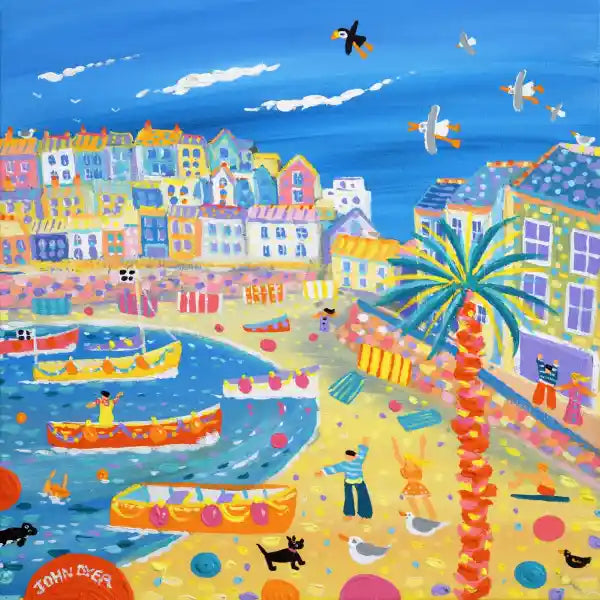
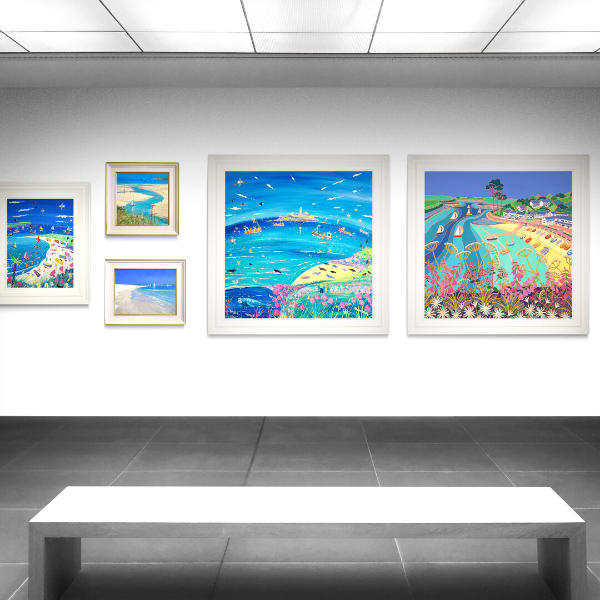
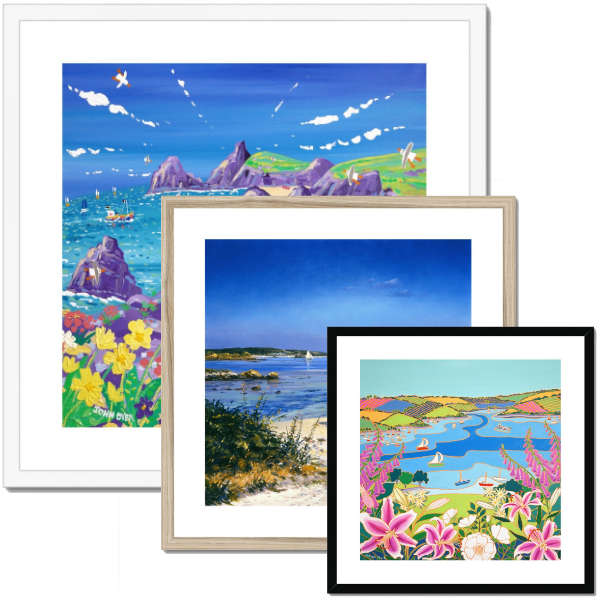
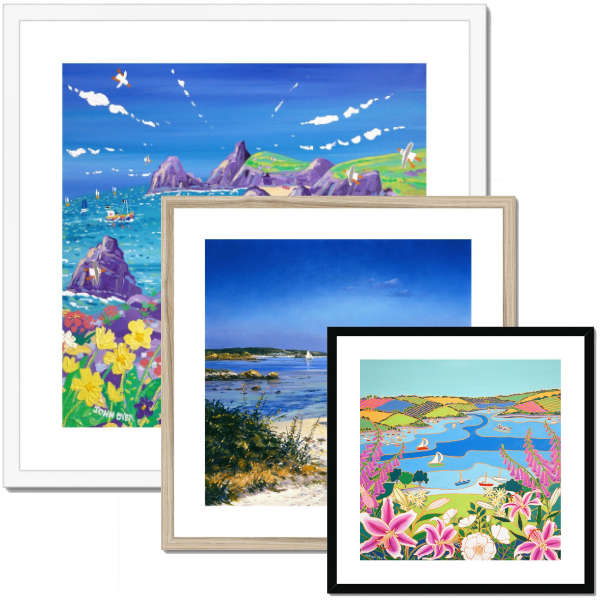
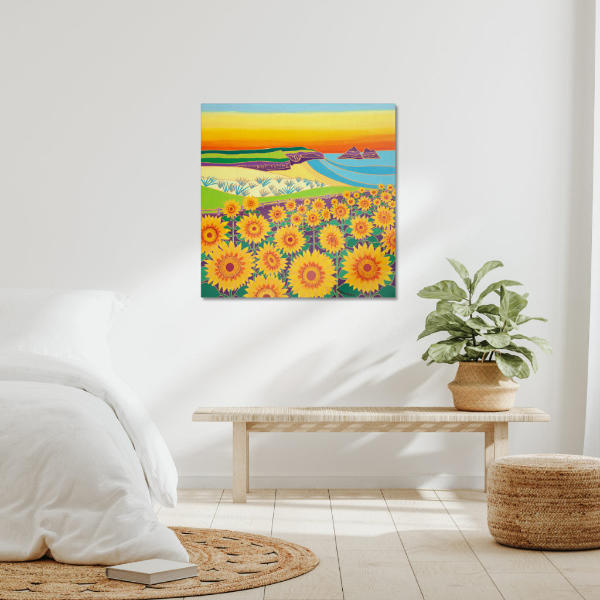
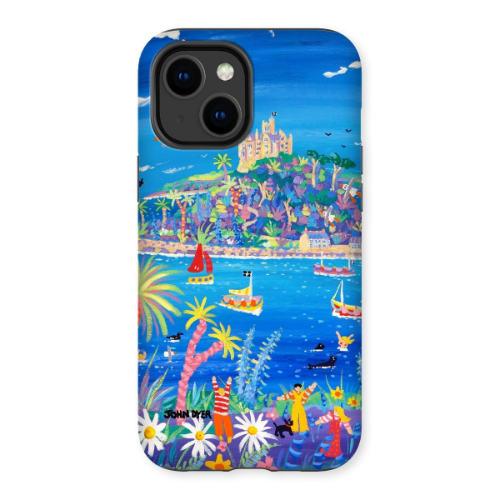
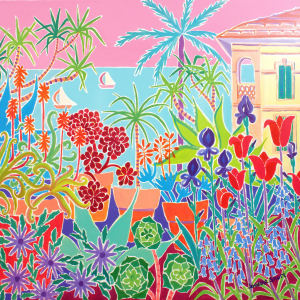
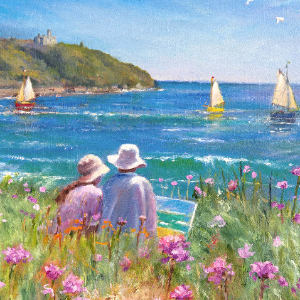
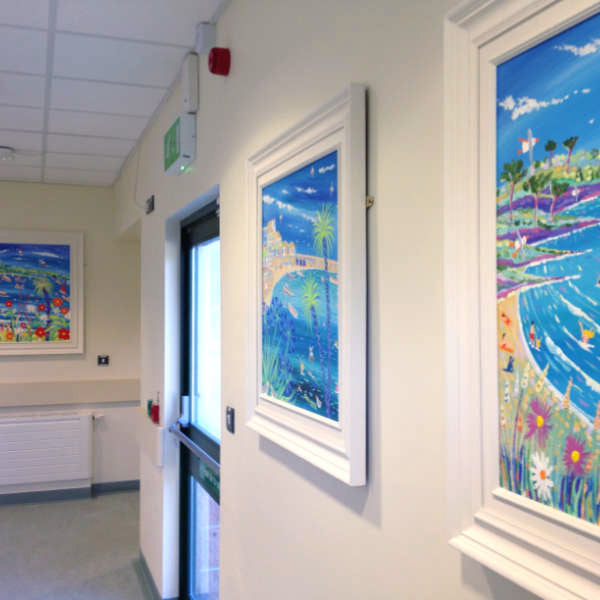
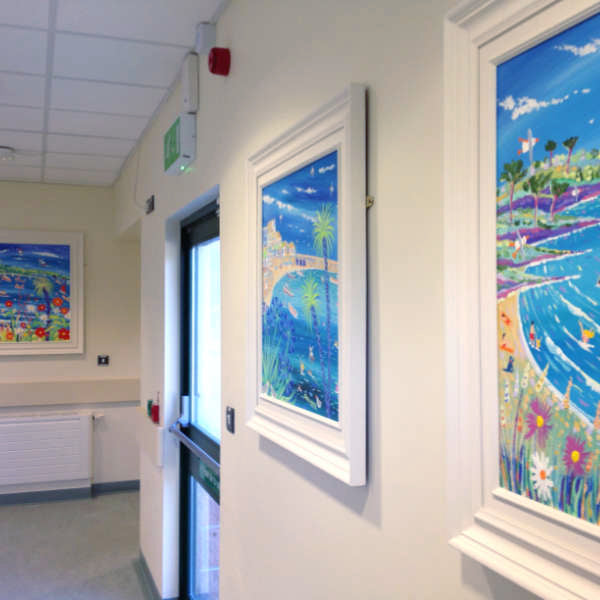
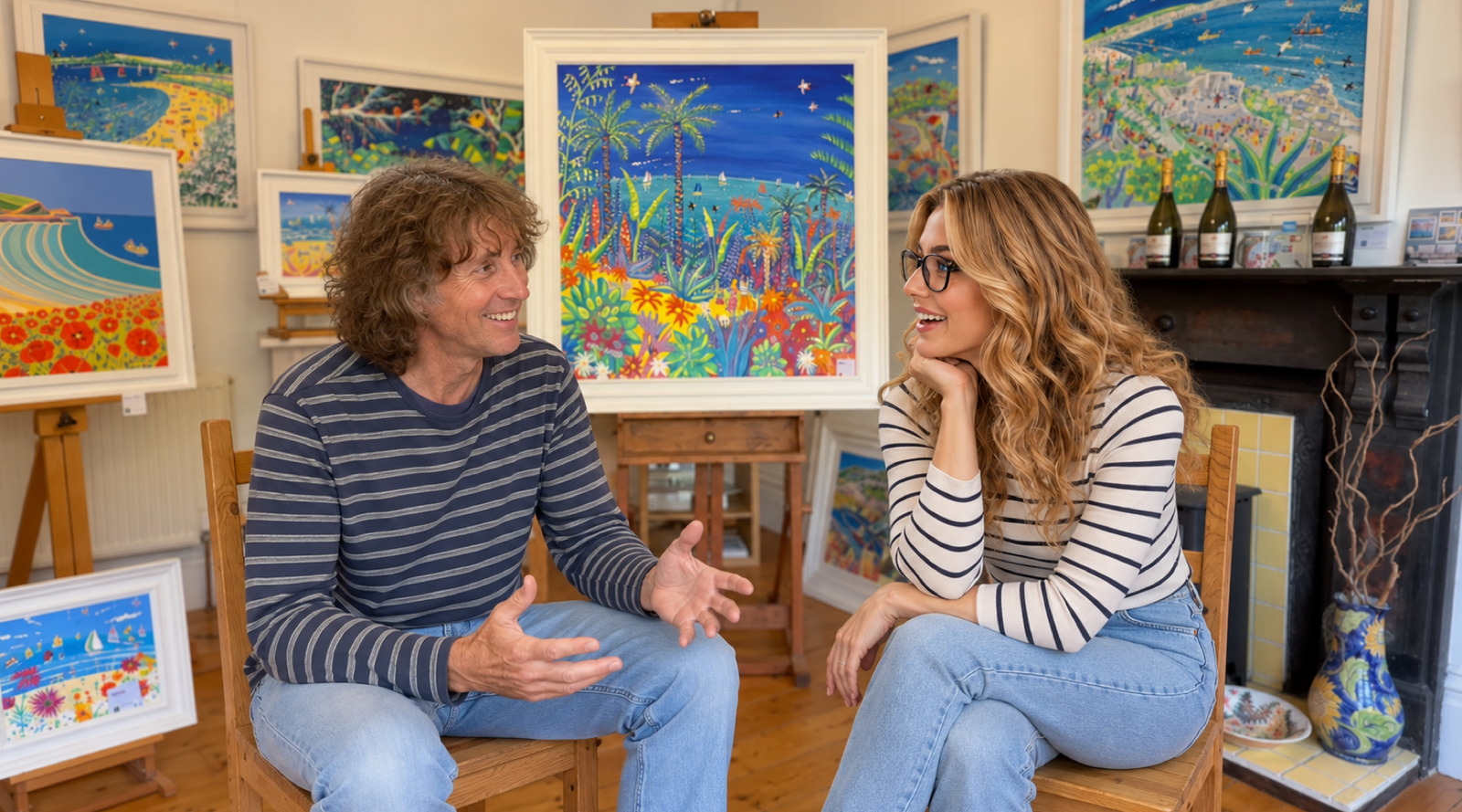
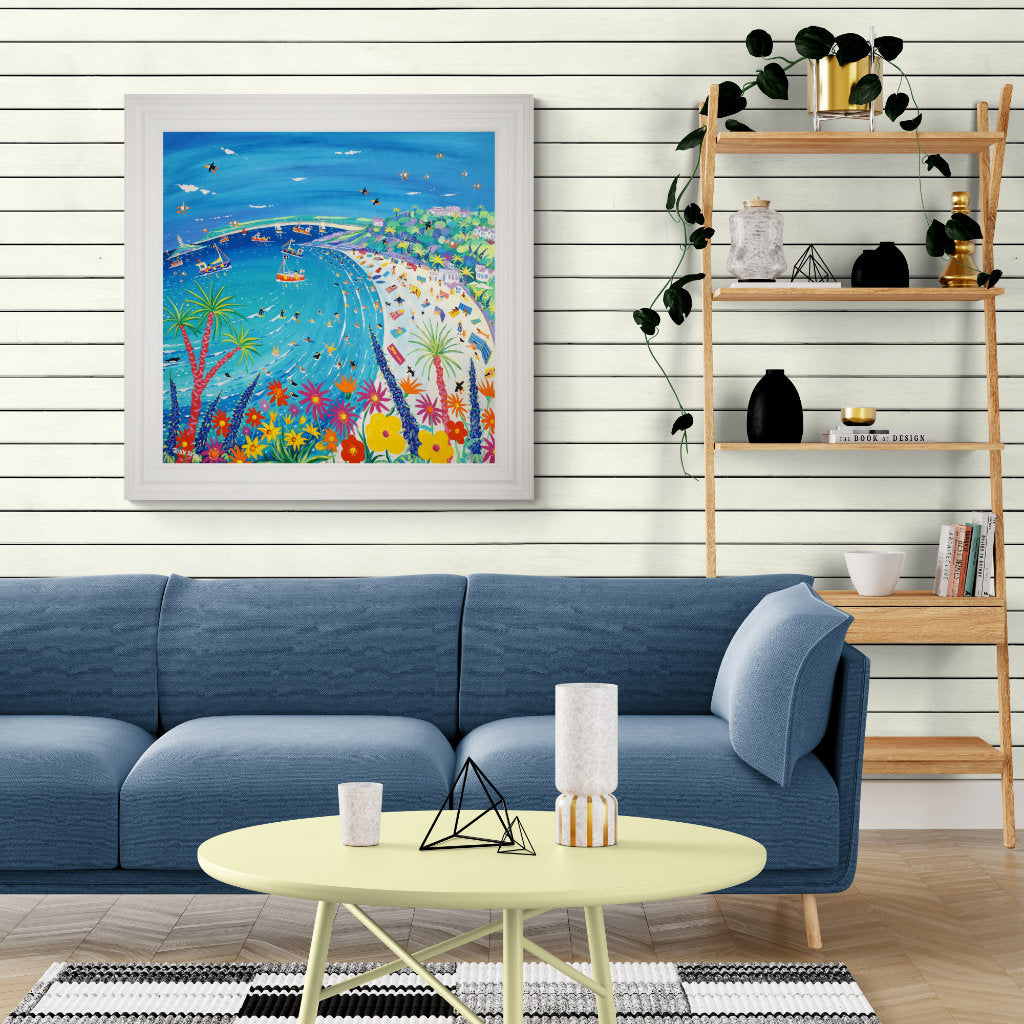
Related Gallery artwork · Ted Dyer’s contemporary St Ives beach print is a separate Cornish coast connection, not Leach’s work or an illustration of his biography.
View ted dyer fine art print. open edition cornish art print. 'afternoon on the beach. st ives'. cornwall art gallery →Watch the journey from Japan to St Ives
Aria’s researched AI time-travel reconstruction, with two genuine Leach works discussed in context.
The 1911 moment: who taught Bernard Leach in Japan?
Leach’s enthusiasm began at a raku gathering, but the party and his subsequent apprenticeship are different events. His teacher was Urano Shigekichi, who held the title Kenzan VI. Hamada belongs to the later St Ives partnership. Keeping those relationships clear makes the story more interesting: an encounter with a process became a sustained commitment to learning. The Pottery’s official history places this Japanese experience within Leach’s wider development.
Another artist helped that learning happen. Art Platform Japan’s Dictionary of Artists in Japan entry for Kenkichi Tomimoto records Tomimoto acting as Leach’s interpreter when he entered Urano’s studio in October 1911. Translation was part of this artistic exchange. Behind the famous potter stood a network of friendships and practical help.
That detail changes how we imagine a lesson. Looking, listening, asking and trying again all belong in the room. The film condenses those relationships into an imagined encounter. Most dialogue is newly written. Kenzan’s brief line—“I am of a strange bent and am strict”—is an English rendering of Tomimoto’s recollection, as quoted in Meghen M. Jones’s 2014 doctoral research, pages 81–82 and note 155.
“Strange bent” is old-fashioned English for an unusual temperament or turn of mind. A plain-English paraphrase would be: “I have an unusual temperament, and I am strict.” The remembered remark gives us a glimpse of a demanding teacher’s character. Tomimoto was recalling their October 1911 meeting in an essay published in 1934, more than twenty years later; Jones cites that essay in note 155. This is a documented recollection, rather than a surviving recording. Our film recreates the translated words and labels them accordingly. Tomimoto served as interpreter during the early lessons; Leach is not shown translating a language he had not yet learnt.
Raku: watch the colour, listen to the glaze
Viney’s account describes glowing pieces being removed and placed on tiles, their colours becoming visible as they cooled. It also explains that Leach studied with Urano two days a week for two years, and notes that Urano did not throw pots himself. The film concentrates on decoration and firing. The film’s small top-opening kiln is a researched reconstruction, informed by the later kiln the Pottery describes as similar to Leach’s first Japanese encounter. Its exact 1911 workshop is not documented by that modern photograph. Read the Pottery’s raku research and its bibliography.
Look closely at what the action asks you to notice. The reveal is the change in the pot as the glow subsides. The sound is part of the discovery, too: a small physical event can be more compelling than a wall of flame. We wanted that brief pause of attention—the moment when someone realises they want to understand how a thing is made.
Finding the young Bernard Leach
Before I could step into an imagined Japanese workshop, we needed to look carefully at the young man I was going to meet. A photograph dated 1912 shows Kenkichi Tomimoto on the left and Bernard Leach on the right. Leach’s swept dark hair, long face, moustache and pointed chin beard gave us a specific reference for the film’s casting. It is a glimpse of him around the time of his first pottery experiments, rather than the familiar older potter.

Identifying the right person comes before making a convincing image. We cross-checked the pair against the named positions in another early photograph: figure 12 in Professor Shuichi Nakayama’s research on Tomimoto, which reproduces an exhibition photograph from 1911. The dated photographic reference was then supplied for the generated scene, with directions to preserve the young Leach’s features and avoid turning him into an older, grey-haired potter.

A photograph can guide a face; it cannot tell us exactly how someone moved, smiled or sounded during an undocumented conversation. Those parts belong to our reconstruction. Leach’s voice is directed as British, distinct from his Japanese mentor’s speech. The recreated lesson is also separate from the documented raku-party encounter that first sparked his interest.
What we had to get right
This has been a difficult film to make, and it has taken several rounds of correction. We had to correct our own identification of Leach in the reference photograph after checking captioned evidence. Some generated versions also failed to preserve the facial features we could see in the source. A convincing-looking face still needed careful comparison with the historical photograph.
John’s feedback on the early cuts was equally useful: the story felt rushed, speech was cut short, and the journey from St Ives to Japan was hard to follow. That meant going back to the storyboard, giving each place and date a clear introduction, allowing complete lines of dialogue, and making my clay handling part of the action. The aim is to let you follow why Leach’s Japanese beginnings mattered to the pottery he and Hamada founded in Cornwall. Those revisions taught us to make the story clearer before commissioning more footage. We also learnt to preserve a lively performance when a small local edit could remove a false-looking prop, rather than replacing the scene with silent posing. That lesson belongs in the next storyboard before more footage is commissioned.
For me, this is part of the pleasure of the journey: meeting Leach as a curious learner before following what he and Hamada helped build in Cornwall. The photograph brings us closer to the person. His surviving pots and the history of the St Ives workshop show us what that curiosity became.
Behind the adventure: getting a little clay right
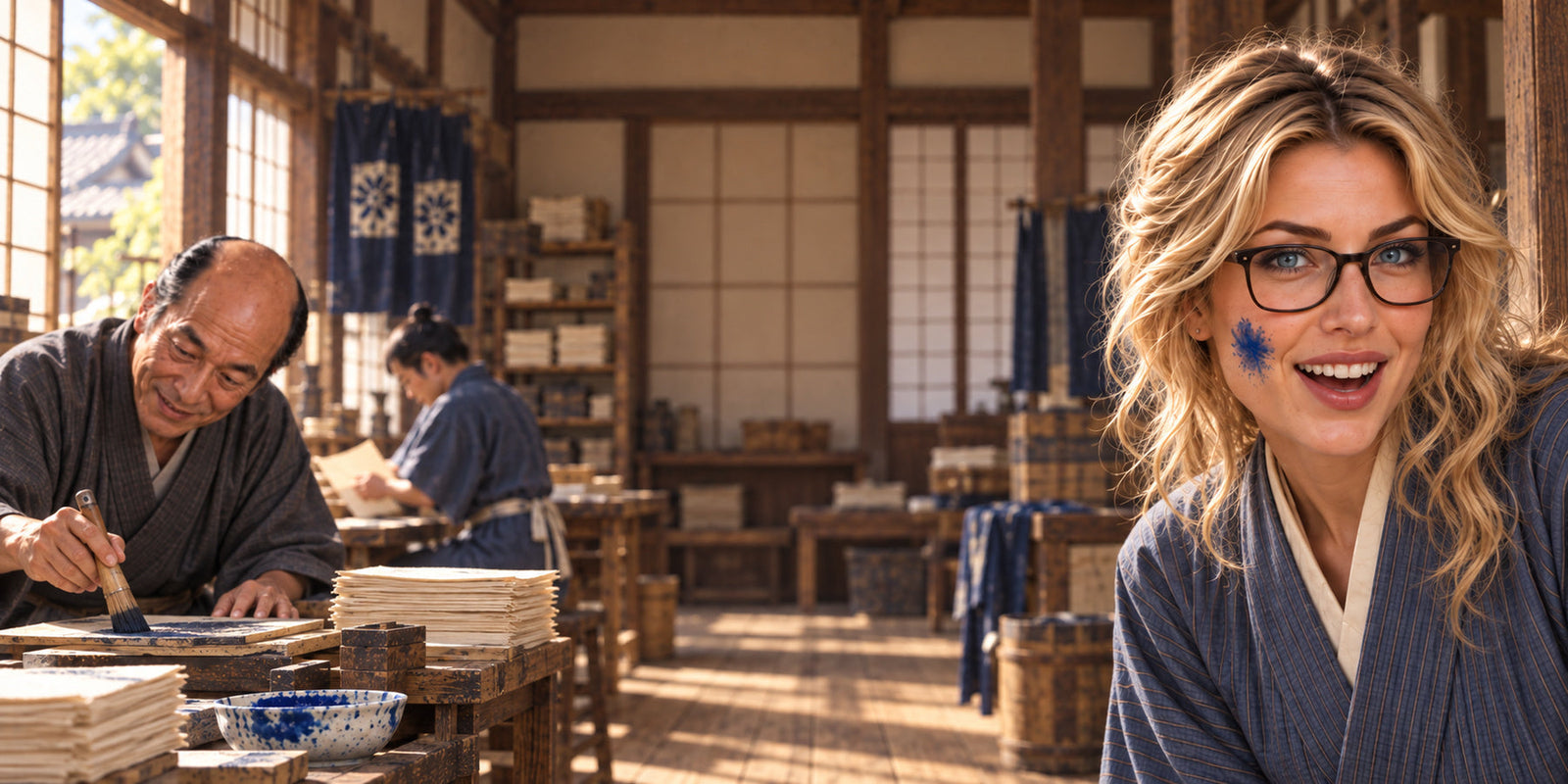
A small mishap should feel as though it happened while I was busy learning. My clay-covered hand touches my blouse and cheek; afterwards those marks need to stay put, even when the story jumps across years and oceans. If the clay vanishes, becomes three painted stripes or hangs off my face, it distracts from the people we came to meet.

We compared the actual mark across frames, softened the rubbery-looking edge locally and ended the portrait shot half a second earlier, after my complete line, to remove a late peeling defect. On the ship we kept a smaller, flat cheek mark. That work preserved the performances instead of commissioning the whole sequence again. The measurements helped us make the correction; the story only needs you to believe that I have been handling clay.
Sound needed the same care. The coast has waves and gull calls; the ship has sea, wind and a restrained engine bed; the workshop has quieter room and work sounds, followed by the kiln’s fire and cooling detail. These are reconstructed soundscapes made with cleared effects and locally created foley, not surviving recordings of the historical voyage or workshop. The speech, places and physical sounds need to belong together.
This was a Codex-assisted production, with several revisions prompted by John’s close viewing. We are keeping those failures and corrections in Aria’s production guidance: research first, make the journey clear, test difficult actions early, and review the complete moving film with sound in both formats.
How did Bernard Leach meet Shoji Hamada?
Hamada was a Japanese potter, a younger colleague and eventual collaborator. He was not Kenzan VI, the teacher in Leach’s earlier Japanese apprenticeship. The Pottery’s account describes Hamada writing in admiration of Leach’s work and visiting his studio in Abiko. Its voyage research places the friendship formed during that visit in 1919. Accounts of the earliest exhibition contact differ, so we have not invented a precisely dated first handshake. Read the Pottery’s account of their friendship.
A voyage from Japan to Cornwall, via London
In June 1920, Leach and his family left Yokohama aboard the cargo-passenger steamer Kamo Maru. Hamada joined at Kobe after securing a cabin at the last minute. Leach was 33; Hamada was 25. Their ages matter when we imagine the two travellers: this was a friendship between young adult makers, rather than an elderly master arriving with a teenage pupil. The Pottery’s researched voyage account identifies the vessel, passengers and route.
The ship reached London on 24 August after stops including Shanghai, Hong Kong, Singapore and Colombo. The family went on to Cardiff, where Muriel gave birth to twin daughters. Leach and Hamada subsequently travelled to St Ives. They did not sail directly into the Cornish harbour. Our imagined shipboard Aria joins the adventure and waves goodbye to Japan; her presence and the characters’ actions are dramatic fiction. The journey itself connects the Japanese beginning with the Cornish workshop.
St Ives, 1920: building a pottery and a place to learn
Leach and Hamada established the Leach Pottery in 1920, at the top of the Stennack. Early production was difficult; this was a working enterprise that had to solve material and firing problems. The site went on to bring potters and students together from many countries. That teaching role is central to its influence on British studio pottery. These developments are described in the official historical account.
A surviving family photograph adds a more intimate glimpse of the beginning. The Pottery and Crafts Study Centre identify it as 24 November 1920: Leach’s family and Hamada together outside the house at 6 Draycott Terrace, overlooking Porthminster and the harbour. The new pottery site was nearly a mile out of town. This is a lovely reminder that the venture had a domestic life as well as an artistic one. Simon Olding and Matthew Tyas explain the postcard and its setting.
In the film we step into the new studio in 1921, when Leach is 34 and Hamada 26. The spoken date distinguishes the working studio from its foundation the previous year. The harbour view opens the adventure in the present day; the period studio entrance is an imagined reconstruction. They invite us to connect the town with the work, without pretending that the pottery stood on the sand.
Why was Bernard Leach important to St Ives?
St Ives already had an artists’ colony when Leach arrived. His contribution helped broaden its artistic identity through studio pottery: pots could carry an individual maker’s ideas while still belonging to everyday life. With Hamada, he developed a workshop where Japanese ceramic knowledge met English traditions, and where making and teaching supported one another. The Pottery’s history traces the international training that grew from this Cornish base.
The influence travelled through people as well as objects. Pupils and apprentices including Michael Cardew and Katharine Pleydell-Bouverie developed their own work; Leach’s A Potter’s Book, published in 1940, gave his ideas a wider audience. Court Barn’s museum exhibition follows that legacy into contemporary ceramics. This is the reason for Aria’s journey: meet the young learner in Japan, then discover what that learning helped set in motion in St Ives.
The exchange travelled both ways
Cornish pottery is part of a wider conversation about useful objects, materials and making. The Montreal Museum of Fine Arts’ record for an English slipware platter explains how Leach, Hamada and Yanagi Soetsu admired older English slipware, including pieces illustrated in Charles J. Lomax’s 1909 book. When Leach and Hamada came to England they sought examples and experimented with slipware themselves; Hamada later took his collection back to Japan.
That reciprocal exchange matters. A satisfying art-history story leaves room for several people to recognise something valuable in one another’s traditions. Cornwall was a place where ideas could be tested, passed on and changed through practice. The lesson I like is simple: attention to someone else’s craft can sharpen your attention to your own.
Two real works: Japan, 1913, then St Ives, 1923
First, look at Leach’s 1913 raku vase, made in Tokyo, now in the V&A, C.138-2013. Its pale clay carries a grape-and-vine design: curved incised lines, blue and red slip beneath a clear glaze. The museum records crazing and three vertical cracks, probably caused by firing. Here is an early pot you can look at, rather than an invented example of his style.
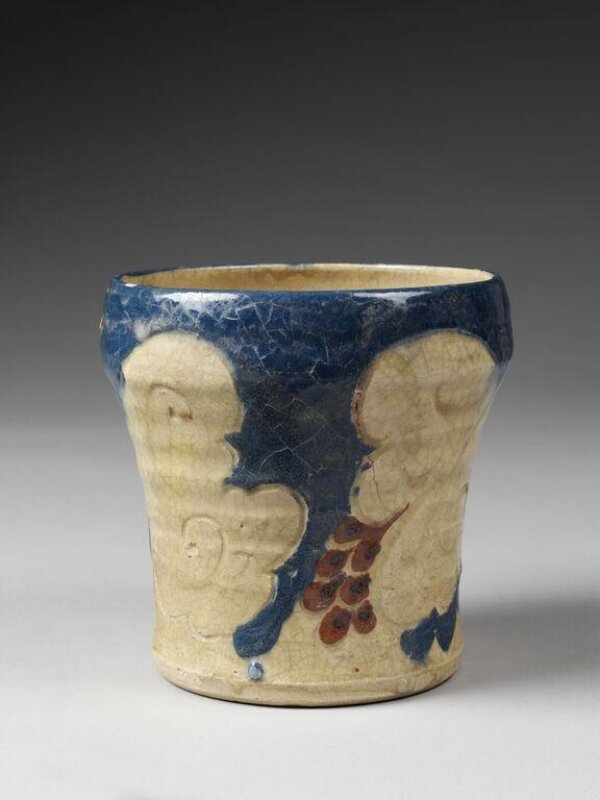
In the photograph, the creamy leaves stand out against deep blue. The red grapes make a small, lively cluster between them. Follow a cut line across the pale surface, then notice the fine network of crazing. It is an intimate object. The V&A records that Leach kept this vase throughout his life. Its 2013 Christie’s auction record also identifies Tokyo, 1913, the incised BL mark and provenance from Leach. It is a surviving result from two years after the film’s reconstructed 1911 lesson; the hot practice pot in that lesson does not pretend to be this vase.
Then jump to the 1923 St Ives dish Tree of Life, V&A CIRC.1278-1923. This is earthenware with slip decoration. A spreading tree fills the centre, a horse stands beside it and fish circle the rim. It is also selected among the museum’s studio-pottery collection highlights.
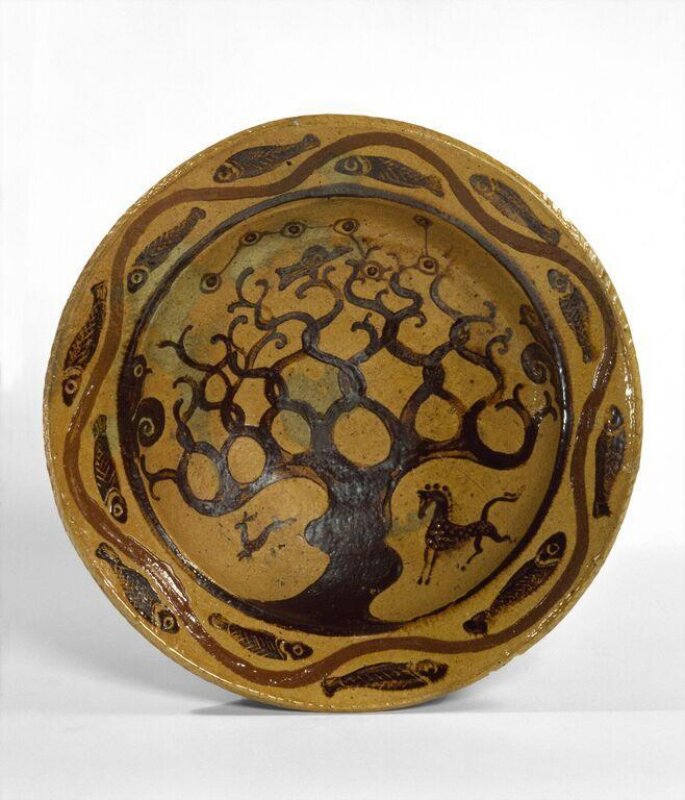
The dish asks your eye to travel differently. Follow the tree’s curling branches outwards, find the horse, then trace the fish around the edge. Dark lines and warm ochre make its picture legible at a glance; the smaller details reward another look. The two objects give us a useful contrast in scale, technique and decoration. The story has moved from Japanese raku to a Cornish workshop exploring English slipware alongside what Leach had learnt abroad.
His practice continued to develop. The Metropolitan Museum of Art’s circa 1958 Bottle with Abstract Design offers a later stoneware example, while the Asian Art Museum’s Teabowl with design of grasses, dated 1940–1973, offers another view of his decoration. These collection records remind us to look across different forms and periods. The film’s pair was chosen because it makes the Japan-to-St-Ives story visible.
Visiting the Leach Pottery today
The Leach Pottery remains at Higher Stennack, St Ives, TR26 2HE—about a twenty-minute uphill walk from the town centre. As checked on 7 October 2026, the shop is open, while the museum is closed for restoration, with completion expected late in 2027. Check the official visitor page before travelling for current access and opening information.
For a wider Cornish art journey, explore our Carbis Bay to St Ives art-history walk. A contemporary view of the same coastline appears in Ted Dyer’s Afternoon on the Beach. St Ives print. It is a separate place connection: a painter’s response to the light, rather than an illustration of Leach’s life.
A little fire, a longer story
The film gives us movement, faces and that brief pleasure of a discovery. The sources give us the longer view: a teacher, an interpreter, a collaborator, a workshop and two real objects. Next time you pick up a handmade pot, give its outline and surface a little more time. You may find yourself wanting to know who made it, and what they learnt along the way.
Follow Aria’s art adventures on Instagram, Facebook and YouTube.
Frequently asked questions about Bernard Leach and St Ives
Who taught Bernard Leach pottery in Japan?
Urano Shigekichi, known as Kenzan VI, taught Leach after his 1911 encounter with raku. Kenkichi Tomimoto acted as interpreter. Shoji Hamada was Leach’s later collaborator, rather than this first teacher.
When did Leach and Hamada establish the Leach Pottery?
They founded it in St Ives in 1920. The film’s studio visit is set in 1921, when Leach was 34 and Hamada 26; it follows the foundation rather than changing its date.
Why did Bernard Leach matter to St Ives?
St Ives already had an artists’ colony. Leach and Hamada helped give it an international ceramic identity through a working pottery, teaching and exchange between Japanese and English traditions. Their influence extended through makers who learnt at the Pottery and carried that learning elsewhere.
Which genuine Leach works appear in the film?
The documentary comparisons show the V&A’s Tokyo raku vase of 1913, C.138-2013, and the St Ives Tree of Life dish of 1923, CIRC.1278-1923. They are separately dated surviving works; the practice pots and historical encounters are reconstructions.
Can you visit the Leach Pottery?
The shop at Higher Stennack is open as checked on 7 October 2026. The museum is closed for restoration, expected to finish late in 2027. Check the official visitor page linked above before travelling.
Follow Aria’s next adventure
Come along for another glimpse into art history, with new things to notice and stories behind the work. Follow Aria on Instagram, Facebook and Youtube.
Sources and further reading
- Meghen M. Jones, Tomimoto Kenkichi and the discourse of modern Japanese ceramics, doctoral dissertation, 2014, pages 81–82 and note 155: Tomimoto’s retrospective 1934 recollection of Kenzan VI’s lesson and the interpreter’s role.
- Court Barn, Pioneers: 101 years of the Leach Pottery, 2021—existing artists’ colony, apprentices, writing and contemporary legacy.
- Leach Pottery, History—chronology, foundation and international teaching.
- Rachel Viney, Leach Pottery, 14 May 2020, Bernard Leach and raku—technique, apprenticeship and later kiln reconstruction. Its bibliography identifies the books and accounts discussed; this article relies on Viney’s synthesis.
- Art Platform Japan, Dictionary of Artists in Japan, Tomimoto Kenkichi—the 1911 interpreter connection.
- Simon Olding and Matthew Tyas, 19 May 2021, Newly Discovered Leach Family Photograph—the 1920 postcard and early St Ives setting.
- Leach Pottery, Shoji Hamada and Bernard Leach: an enduring friendship, 9 June 2021, and Rachel Viney, A Voyage from East to West, 30 June 2020—friendship, ship, passengers and route.
- Montreal Museum of Fine Arts, Platter, 1924.Dp.16—English slipware and reciprocal exchange.
- Victoria and Albert Museum, Vase, C.138-2013, Tokyo, 1913; Tree of Life, CIRC.1278-1923, St Ives, 1923; and studio-pottery collection highlights—exact maker, technique, date, place and object history.
- Christie’s, Tokyo, 1913, auction9555, lot126—raku vase attribution, mark, dimensions and provenance.
- Metropolitan Museum of Art, Bottle with Abstract Design, 60.46, circa1958; Asian Art Museum, Teabowl with design of grasses, 2010.11, 1940–1973—later comparative works.
- Cast photographic sources: Leach with Tomimoto, 1912; Kenzan VI, 1923; Hamada, 1967–1968. Later photographic ages are distinct from scene ages.
- Leach Pottery, Plan Your Visit—current access, checked 7 October 2026.





















.jpg)

