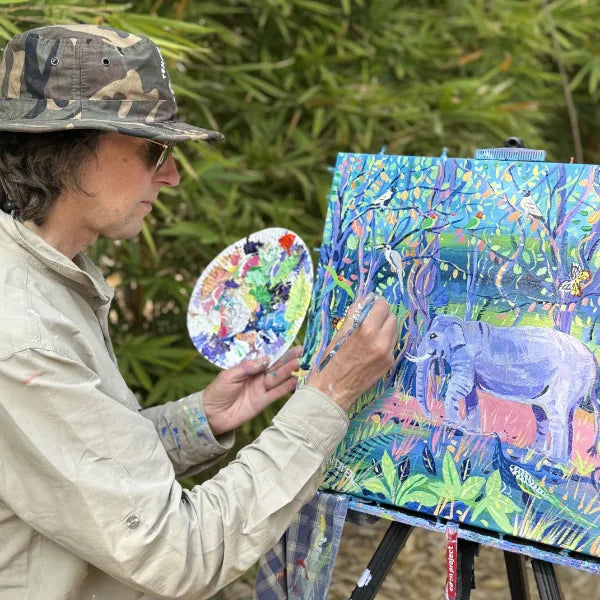
We Are All the Forest, Pench, India was painted as part of John Dyer’s Land of the Tiger – Last Chance to Paint expedition and celebrates the extraordinary wildlife, people and spirit of the dry tropical forest of Pench in central India.
The painting captures the forest in the luminous colours of an early-morning safari, as the sun rises behind the trees and the jungle begins to wake. Golden yellows, fresh greens, blues and flashes of orange fill the canvas with light and energy.
A Bengal tiger moves quietly through the forest alongside an Indian elephant, spotted deer and sambar deer. Above them are black drongos, Indian grey hornbills and rose-ringed parakeets, while striped tiger butterflies float through the warm morning air. In the foreground, a Gond tribal goat herder walks with his animals, placing human life within the same living landscape as the wildlife.
Central to the painting is the idea of co-existence. Look carefully and the boundaries between the animals and the forest begin to disappear. The spotted deer in the lower left seems to grow directly into the vegetation, while the elephant is similarly woven into the trees and looping forms of the jungle.
This reflects ideas John encountered through Gond culture and Gond art, in which people, animals, plants and the forest are understood as interconnected rather than separate. The painting’s title, We Are All the Forest, expresses that idea directly: every animal, person, tree, bird and butterfly belongs to the same living system.
Pench also has a powerful literary association with Rudyard Kipling’s The Jungle Book, whose imagined jungle landscape was inspired by the forests and wildlife of this part of central India. John Dyer’s painting brings that legendary landscape into the present day — not as a fictional wilderness, but as a real and precious ecosystem in which tigers, elephants, deer, birds, butterflies and people continue to coexist.
Rich with observation, symbolism and colour, this original painting is both a joyful celebration of India’s wildlife and a reminder that the survival of the forest depends upon recognising that we are not separate from nature — we are part of it.
| Description |
Framed Original Painting |
| Artist |
Cornish Artist John Dyer (born 1968) |
| Signed by the Artist |
Signed by John Dyer |
| Painting size |
24 x 24 inches |
| Medium |
Acrylic on canvas |
| Framed size |
29.5 x 29.5 inches |
| Frame type |
The St Ives style picture frame is a Renaissance-inspired cassetta frame, Italian for 'little box', featuring a white stain finish that highlights the wood grain. With a 73mm wide profile and 39mm depth, it creates a recessed central panel, perfect for a timeless, contemporary and elegant display of the painting |
| Ready to hang |
Strung with picture cord and ready to hang |
Explore the Indian Summer collection.